Can Phone Data or Cloud Evidence Be Challenged in Court
In many modern criminal cases, text messages, app activity, location data, and cloud-stored files become the primary evidence for prosecutors, especially when there is limited physical evidence.
While digital records can appear precise, the way data is collected, interpreted, and presented can raise legal and technical issues. In some cases, those issues may affect whether the evidence can be used in court.
How Phone Data and Cloud Accounts Become Evidence
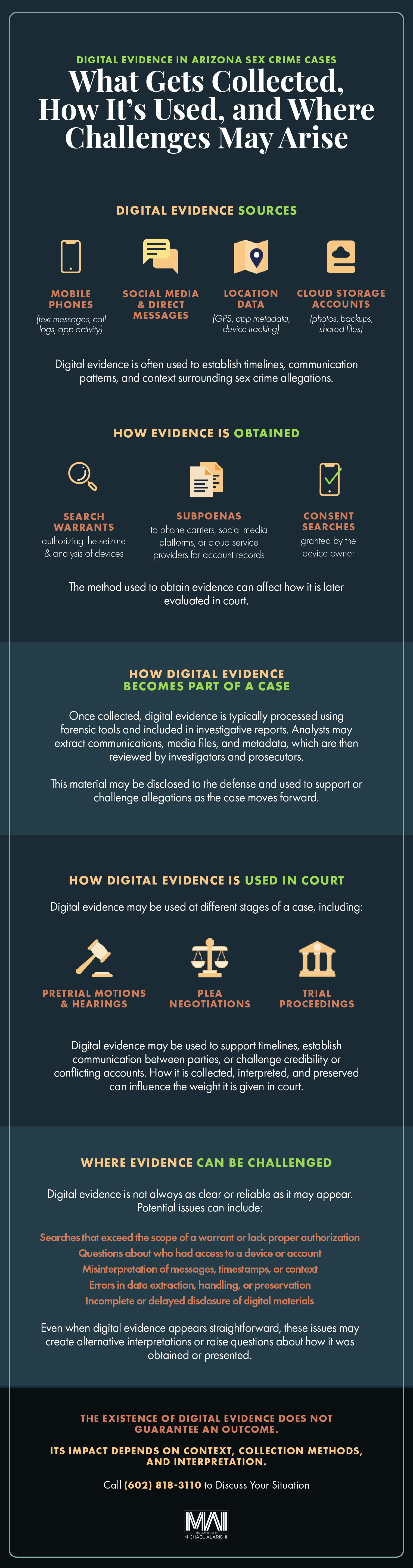
Investigators routinely rely on digital evidence from phones and online accounts for drug crimes, property crimes, sex crimes, and violent crimes. This can include:
- Text messages and call logs
- Photos and videos stored on a device
- Data from apps, including social media and messaging platforms
- Location data from GPS, apps, or cell towers
- Files and backups stored in cloud accounts
This information may be obtained in several ways. Law enforcement may:
- Perform a forensic extraction of a physical device
- Access account data through a search warrant
- Request records from service providers
Because different types of data are stored in different places, a single investigation may involve multiple sources of digital evidence.
Search Warrants vs. Subpoenas for Digital Evidence
The method used to obtain digital evidence matters. Search warrants and subpoenas operate under different legal standards and allow access to different types of information.
- A search warrant generally requires probable cause and approval from a judge. It may allow investigators to search a device or access the contents of an account.
- A subpoena typically has a lower legal threshold and is often used to obtain records from third parties, such as account subscriber information or logs maintained by service providers.
The distinction can become important when evaluating whether law enforcement accessed content that required a warrant but instead relied on a subpoena.
Common Issues With Digital Evidence Collection
Digital evidence collection is highly technical and must follow specific legal and procedural rules. Problems can arise at multiple stages, including:
- Warrants that are overly broad or lack sufficient detail
- Collection of data outside the authorized scope of a warrant
- Timing issues involving when data was accessed or seized
- Requests made to third parties that exceed what is permitted
- Attempts to recover deleted or encrypted data without proper authorization
Even when evidence appears straightforward, the underlying process used to obtain it can raise questions.
Chain of Custody and Data Integrity
Once digital evidence is collected, it must be preserved and documented properly. This process is often referred to as the chain of custody.
Investigators typically use forensic tools to extract and analyze data. These tools are designed to avoid altering the original data, but errors can still occur. Issues that may arise include:
- Incomplete or inconsistent documentation of how data was handled
- Gaps in the chain of custody
- Questions about whether the data was altered or corrupted
- Use of forensic tools without proper validation or documentation
If the handling of digital evidence is unclear or inconsistent, it may affect how that evidence is viewed in court.
How Phone Data and Cloud Evidence Can Be Challenged
Challenges often arise due to the ways in which digital evidence was obtained and analyzed. Some of the common scenarios include:
- Lack of probable cause supporting a search warrant
- Improper use of a subpoena to obtain content rather than basic records
- Violations of constitutional protections during the investigation
- Data attributed to the wrong person or account
- Misinterpretation of timestamps, metadata, or location data
- Failure to follow accepted forensic procedures
Police, prosecutors, and companies are held to complex data privacy and legal requirements. Procedural errors don’t occur in every case, but they can happen.
Data is also limited in what it can establish. Prosecutors typically make inferences that support their narrative, but there is often room for interpretation. In some cases, the issue is not whether the data exists, but whether it reliably shows what the prosecution claims it shows.
Speak With a Phoenix Criminal Defense Attorney About Digital Evidence in Your Case
Expert analysis and cross-examination can be vital when cases with limited physical evidence rely heavily on digital records. Arizona board-certified criminal defense attorney Michael Alarid III has extensive experience reviewing warrants, subpoenas, and data handling practices in search of mistakes or misinterpretation.
Call (602) 818-3110 to schedule a consultation and discuss your case.
Practice Areas
RECENT NEWS