Does Intent Matter in Criminal Defense?

In criminal law, intent often influences how a case is charged and defended. Establishing what a defendant was thinking at the time of an alleged offense can mean the difference between conviction and acquittal, between a felony and a misdemeanor, and between jail time and probation.
The Role of Intent in Arizona Criminal Law
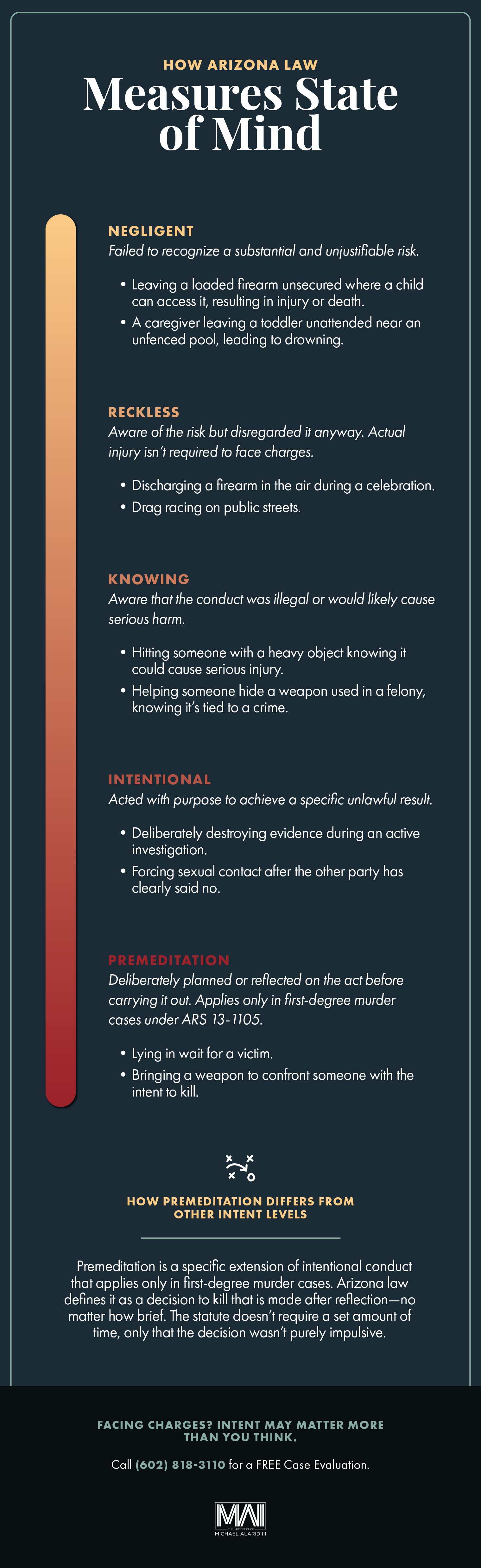
Intent is a mental state that the law considers when defining crimes. Arizona statutes specify different mental states, including knowingly, intentionally, recklessly, and negligently, depending on the offense.
Intentional Conduct
A person acts intentionally when their objective is to cause a specific result. Crimes requiring intentional conduct often involve allegations that the act was purposeful rather than accidental or reactive. For example, a person who deliberately sets fire to property for the purpose of destroying it is acting intentionally.
Knowing Conduct
Knowing conduct involves awareness that a particular result is practically certain to occur, even if causing that result was not the person’s primary goal. For example, if a person fires a gun into a crowded area to target a specific individual, they understand that serious injury to others is practically certain, even though harming them is not the goal.
Reckless Conduct
Recklessness involves conscious disregard of a substantial and unjustifiable risk. The distinction between recklessness and intentional conduct can significantly affect charge severity.
An example would be a driver speeding, weaving through traffic, or driving while intoxicated. They may believe they can avoid a crash, but they still understand that their behavior is putting others at serious risk.
Criminal Negligence
Criminal negligence applies when a person fails to perceive a risk that a reasonable person would have recognized. While still serious, negligence is treated differently than purposeful or knowing conduct.
Leaving a loaded firearm unsecured in a home without realizing a child could access it may be criminally negligent if someone is injured as a result. They did not intentionally or knowingly give the child access to a firearm. They may not have even realized the threat existed, but their lapse still led to an injury or death.
What Prosecutors Must Show to Prove Intent
Because prosecutors and juries can’t read minds, courts rely on evidence to establish what a defendant was thinking. Direct evidence of intent is rare. Instead, prosecutors typically rely on circumstantial evidence such as:
- Statements made before or after an incident
- Actions taken leading up to the alleged offense
- Digital communications, search history, or location data
- Surveillance footage or third-party observations
- The nature and timing of the conduct itself
- Patterns of behavior
For example, in an aggravated assault case, evidence that a defendant struck a victim repeatedly after a verbal exchange may support an inference of intent.
In property crime cases, the prosecution might point to how the defendant concealed tools or planned entry, suggesting purposeful conduct.
Defenses That Rely on Lack of Intent
Many criminal defenses turn on showing that the defendant lacked the level of intent alleged by prosecutors. Classic defenses include mistake of fact, accident, and lack of knowledge.
A bar fight might lead to assault charges, but if the defense can show the injury occurred in the heat of mutual combat without intent to seriously harm, it may reduce the severity of the charge or support a self-defense argument.
These defenses are fact-specific and require thorough investigation. Statements taken without counsel, inconsistent witness testimony, lack of forensic linkage, or procedural errors can all undermine the state’s ability to prove intent.
Intent in Drug, Property, Violent, and Sex Crimes
Intent plays out differently across crime categories. In drug cases, prosecutors often try to distinguish possession from trafficking by highlighting quantity, packaging, scales, or financial records as evidence of an intent to sell. The defense may counter by showing that the drugs were for personal use or were possessed unknowingly, challenging whether intent to distribute can be proven.
In property crimes, intent determines whether unauthorized entry was criminal trespass or burglary. Burglary requires intent to commit a theft or felony inside the structure. Without clear evidence of that intent, the lesser trespass charge might be appropriate.
In an assault case, defense attorneys may argue their client intended only to defend themselves, break up a fight, or intimidate, not injure, depending on how the incident unfolded. That distinction can mean the difference between a felony assault charge and a misdemeanor or even dismissal.
In sex crime cases, consent and intent often form the core of the dispute. For example, a charge of sexual assault requires proof that the defendant intentionally engaged in sexual contact knowing the other person did not or could not consent. If the defendant reasonably believed consent was given, even if that belief was mistaken, the state may not be able to prove the required intent beyond a reasonable doubt.
When Intent Is Presumed or Inferred
Arizona law allows juries to infer intent from conduct, circumstantial evidence, and logical reasoning. The key limitation is that any inference must be reasonable. Jurors cannot guess or speculate. They must connect the dots from what is known to what the defendant likely intended.
Cases involving recklessness or negligence focus less on purpose and more on awareness of risk. Recklessness involves conscious disregard of a substantial risk.
Defense attorneys often challenge whether the defendant actually recognized the risk or whether the conduct falls within what a reasonable person would foresee.
Why Intent Can Make or Break a Defense Strategy for Phoenix Defendants
Many charges require mental states that are open to interpretation. Criminal defense attorneys evaluate whether the prosecution can prove mental state beyond a reasonable doubt, and if not, they pursue motions to dismiss, negotiations for reduced charges, or trial strategies that highlight reasonable doubt on intent.
Intent analysis also affects plea negotiations and sentencing. Showing that a defendant lacked intent can lead prosecutors to reduce charges, which in turn can lessen potential penalties. At sentencing, the presence or absence of intent influences aggravation and mitigation factors.
Arizona board-certified criminal defense attorney Michael Alarid III can explain how intent is defined under Arizona law and how it may or may not affect your specific circumstances. You can discuss your situation during a free case evaluation by calling (602) 818-3110.
Practice Areas
RECENT NEWS