What Can Help Reduce a Criminal Sentence in Arizona?
A criminal conviction does not always result in a predetermined sentence. Depending on the offense, Arizona judges may have discretion to impose a sentence within a range established by state law.
When that discretion exists, mitigating circumstances may influence the sentence a defendant receives. These circumstances can include factors related to the offense, the defendant's background, and actions taken before sentencing.
However, not every mitigating factor carries the same weight, and the sentencing discretion of a judge is still constrained by Arizona law.
What Counts as a Mitigating Circumstance in Arizona?
Under ARS 13-701, Arizona courts may consider several mitigating circumstances when determining a sentence for a felony conviction, including:
- The defendant's age
- Whether the defendant's ability to appreciate the wrongfulness of their conduct was significantly impaired
- Whether the defendant acted under unusual or substantial duress
- Whether the defendant played a relatively minor role in the offense
- Other relevant circumstances concerning the defendant's character, background, or the nature of the offense
There is not a fixed list of mitigating factors with assigned values in Arizona statutes.
Judges have significant latitude for interpreting and weighing those factors as long as the sentence remains within the ranges dictated by state laws.
Can Taking Responsibility Before Sentencing Make a Difference?
Taking responsibility may make a difference in some cases, particularly when it demonstrates an effort to address past behavior or prevent future offenses.
For example, voluntarily completing substance abuse treatment or participating in counseling may demonstrate that a defendant is taking steps to address an underlying problem.
Making restitution or otherwise addressing financial harm may also be relevant, especially in cases involving theft, fraud, or property damage.
Maintaining employment, supporting family members, and fulfilling community responsibilities can provide additional context about the defendant's circumstances.
However, the significance of these actions depends on the offense and the individual case. Completing a treatment program does not guarantee leniency, and actions that may be persuasive in one case may have little influence in another.
Defendants should also discuss potential admissions with their attorney before making statements. Taking responsibility may be well-intentioned, but statements about guilt, motivations, or state of mind can carry legal consequences.
How Much Weight Do Judges Give Mitigating Evidence?
It's difficult to predict how much weight a judge will give mitigating evidence because its significance depends on the circumstances of the individual case, including:
- The seriousness of the offense
- The extent of harm suffered by the victim
- The defendant's prior criminal history
- Any legally established aggravating circumstances
- Public safety concerns
The relationship between the mitigating evidence and the offense may also matter. For example, a judge may view evidence of completed drug treatment differently when the defendant was convicted of stealing to support an addiction. The treatment directly addresses a factor that contributed to the offense.
Can Mitigating Evidence Influence Plea Negotiations?
In some circumstances, mitigating evidence may influence a prosecutor's willingness to offer reduced charges or a more favorable plea agreement.
This can be particularly important when the original charges carry mandatory prison sentences or other sentencing restrictions that would constrain a judge.
However, prosecutors are not required to offer reduced charges or more favorable terms simply because mitigating evidence exists. The outcome depends on the offense, the evidence, the defendant's criminal history, and the circumstances of the case.
How Can a Criminal Defense Attorney Present Mitigating Circumstances?
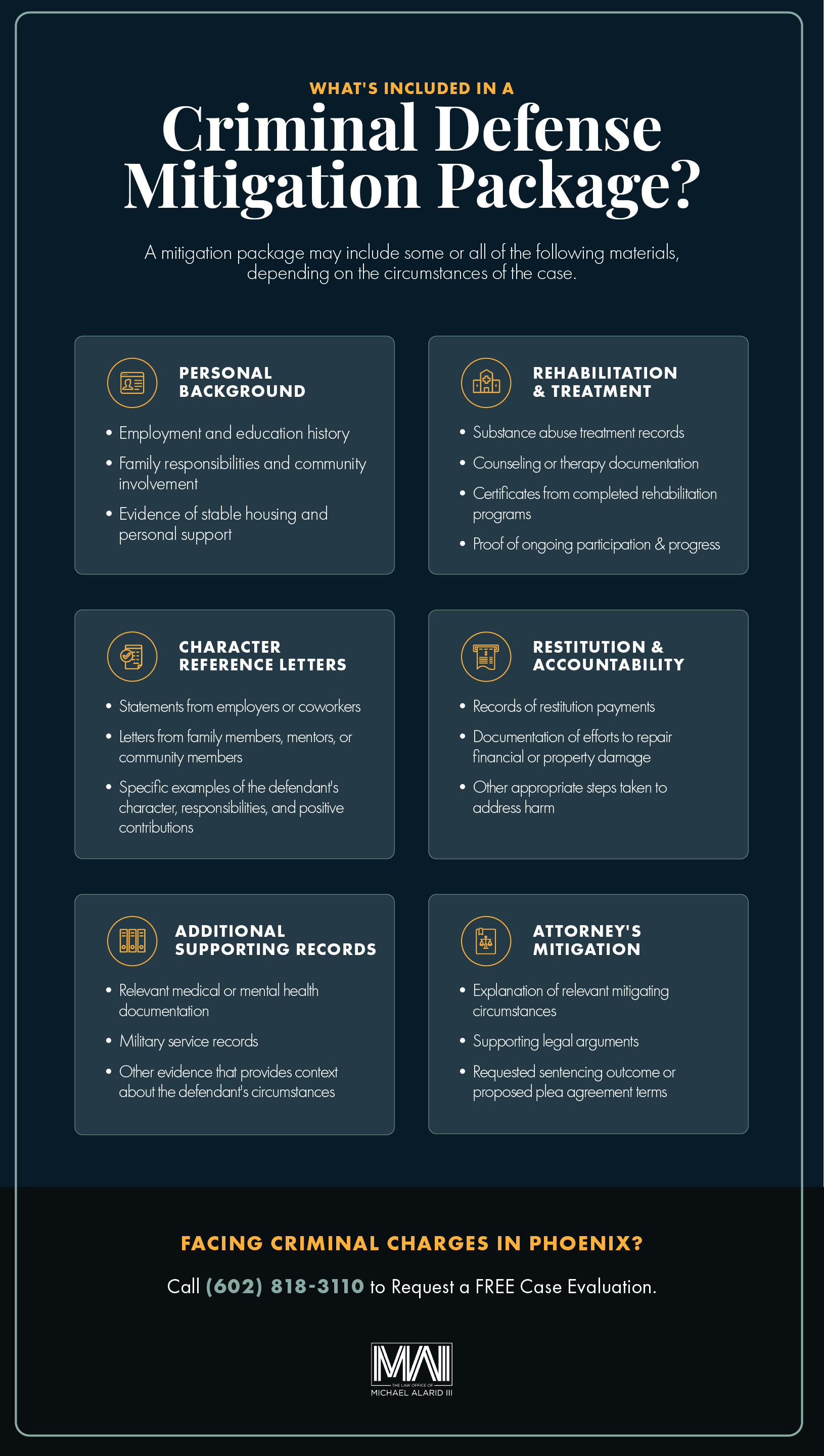
A criminal defense attorney may create a ‘mitigation package’ containing supporting records, statements, and documentation detailing the defendant's background, personal circumstances, conduct following the alleged offense, and other factors that could be relevant to sentencing.
That package can then be presented to prosecutors during plea negotiations or to judges during sentencing proceedings.
A criminal defense attorney can evaluate the evidence, explain the potential sentencing consequences, and develop a defense strategy that accounts for both the charges and your individual circumstances.
You can discuss your situation with Arizona Board-Certified Criminal Defense Attorney Michael Alarid III by calling (602) 818-3110 for a free case evaluation.
Practice Areas
RECENT NEWS